Newark Police Department
The Plot Against AmericaThe Newark Police Department becomes a visible instrument of civic protection as anti-Semitic violence spreads and Newark’s Jewish residents prepare for attacks. Its actions range from school and neighborhood patrols to emergency coordination with community leaders, but the gun battle with the Provisional Jewish Police exposes the instability of that protective role: the city’s police and a Jewish volunteer force, formed because residents feared official protection might fail, end up in armed conflict.
Emergency planning and civic authority
After violence in other cities raised fears that Newark could also face attacks, Rabbi Prinz and other prominent Jewish residents organized the Newark Committee of Concerned Jewish Citizens. The committee met with the police chief, fire chief, and director of public safety at City Hall, then conferred with state officials in Trenton. These meetings made the Newark Police Department part of a formal effort to prepare for possible violence rather than wait for it to arrive. Attorney General Wilentz assured Rabbi Prinz that assaults on Newark’s Jews would be prosecuted to the fullest extent of the law.
The department’s assurances were put into practice around the schools. At Chancellor Avenue School, administrators and civic representatives explained safety measures to pupils and families. A deputy from Mayor Murphy’s office said extra police details would patrol the neighborhood until normal conditions returned; uniformed officers were to be stationed at each school entrance and in the corridors. The measures made police presence part of children’s daily routine, extending protection into the places where families expected them to be safest.
Patrols during the crisis
The department’s presence also extended beyond schools. As fears sharpened, armed Newark police walked local beats and drove through neighborhood streets in squad cars. Their patrols offered some reassurance to residents, but did not remove the sense of danger. When Bess Roth went out to shop, the sight of city police offered only slightly more comfort than the local Jewish volunteers patrolling nearby.
A specific deployment plan followed reports of attacks in surrounding areas. The entire mounted-police complement—two platoons of twelve, divided among four precincts—was to patrol streets west of Weequahic and south toward Union County, including the approaches to Hillside and Elizabeth. The plan reflected how the perceived threat was mapped onto the geography around Newark’s Jewish neighborhood, with patrols concentrated near its borders and near sites recently affected by vandalism and arson.
Mounted officers also carry an older, more complicated association in the narrator’s recollections. Years earlier, a mounted policeman’s pursuit of a purse-snatcher in Weequahic Park had seemed gallant to a child; mounted officers were also known to charge into strike crowds and scatter picketers, to the narrator’s father’s chagrin. The same force that could signify order and inspire confidence thus also embodied the power used to control public protest.
The clash with the Provisional Jewish Police
The department’s protective role collided with the neighborhood’s self-defense preparations. Longy Zwillman separately arranged for Bullet Apfelbaum to recruit local Jewish men into the Provisional Jewish Police, a volunteer force formed amid fears that municipal officers and state troopers might respond to anti-Semitic disorder as slowly as police had in Boston and Detroit. The volunteers’ presence reflected distrust as well as fear: community members sought protection while preparing for the possibility that official authorities would not provide it.
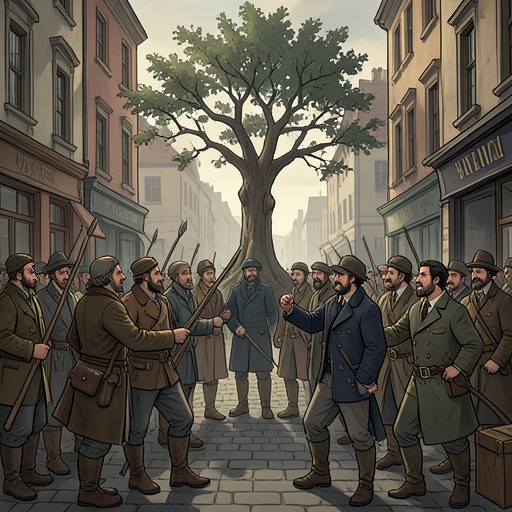
During a night of gunfire near Chancellor Avenue, residents initially feared a clash with anti-Semitic attackers. By dawn, they learned that the shooting had been between the city police and the Provisional Jewish Police. Three volunteers—Duke Glick, Big Gerry, and Bullet Apfelbaum—had been killed. The police commissioner’s account was that the Jewish volunteers opened fire without provocation on two foot patrolmen shortly before midnight. Neighbors did not accept that explanation as a complete account, but the narrator also notes that those killed were dangerous men whom respectable residents would not ordinarily have asked to protect them. The confrontation was therefore neither a pogrom nor a simple story of public protection: it was an armed conflict between municipal officers and a local force created in response to the fear of mob violence.
Limits of protection under martial law
As the crisis widened nationally, the Newark Police Department operated within a larger emergency structure. After martial law was imposed across the continental United States and its territories and possessions, Acting President Wheeler said that the armed forces would maintain order in Washington, while the National Guard, the Federal Bureau of Investigation, and local police authorities would cooperate elsewhere. The announcement placed municipal departments inside a nationwide system of emergency enforcement, even as the earlier Newark events had already shown that police protection could be both urgently sought and deeply contested.